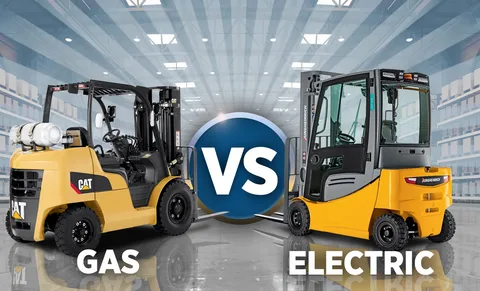
It is one of the most common questions we get at Local Forklifts. You have figured out what type of machine you need. Now you are stuck on fuel. Propane or electric?
Propane has been the default choice across DFW warehouses and job sites for decades, and for good reason. It is powerful, flexible, and fast to refuel. But electric forklifts are gaining serious ground as battery technology improves and operating costs become harder to ignore.
The honest answer is that neither is universally better. The right choice depends on where the machine will run, how many hours a day it needs to operate, what industry you are in, and how long you plan to own it. This guide walks through all of it so you can make the call with clear information rather than guesswork.
Quick Comparison: Electric vs Propane Forklift
| Factor | Electric | Propane |
| Upfront cost | Higher ($35,000 to $40,500) | Lower ($24,000 to $30,000) |
| Operating cost | Lower (around $1.25/hr) | Higher (around $2.00/hr) |
| Maintenance | Lower (fewer moving parts) | Higher (engine service required) |
| Runtime per shift | Limited by charge cycle | Continuous with tank swap |
| Indoor use | Yes, preferred | Yes, with proper ventilation |
| Outdoor use | Limited | Yes |
| Emissions | Zero | CO and CO2 produced |
| High-capacity options | Good to around 40,000 lbs | Better above 40,000 lbs |
| Cold weather performance | Handles well | Can struggle to start |
| Refuel or recharge time | 8-hour charge cycle | Under 1 minute tank swap |
Upfront Cost vs Total Cost of Ownership
Propane forklifts are cheaper to buy. That is simply true and worth saying plainly. A standard 5,000-pound capacity propane forklift runs between $24,000 and $30,000 new. An equivalent electric model comes in at $35,000 to $40,500, with the battery accounting for $7,000 to $9,000 of that and the charger adding another $3,000 to $5,000 on top.
That is a meaningful upfront gap. If budget is tight or the machine is only going to be used occasionally, propane’s lower purchase price is a legitimate advantage.
Where the math flips is over time. Operating an electric forklift costs approximately 75% less than running a propane unit across its working life. Electricity to run a standard electric forklift runs around $1,192 per year based on typical usage figures and current industrial electricity rates. Propane costs more to fuel and more to maintain, and those costs compound month after month.
Propane prices also fluctuate in ways electricity rates generally do not. Across Texas, LP prices track national commodity markets and can spike during winter months or during periods of supply disruption. Electric operating costs are far more predictable.
The general rule of thumb is that most operations running their equipment daily recover the electric price premium within two years. For businesses planning to own the equipment for five years or more, electric almost always wins on total cost.
If you are buying one unit for a few hours of use each week, propane may make more financial sense. If you are running it hard across one or more shifts every working day, electric is worth the higher upfront investment.
Maintenance
This one is not close. Electric forklifts have approximately 20 moving parts. A propane forklift engine has close to 2,000. That difference runs all the way through the ownership experience.
Propane forklifts require scheduled oil changes, engine tune-ups, spark plug replacements, air and fuel mixture adjustments, cooling system maintenance, and filter replacements. It is similar in scope to maintaining a fleet vehicle. The cost works out to roughly $2.00 per operating hour.
Electric forklifts do not have motor oil, an exhaust system, a transmission, or an ignition system. The maintenance list is significantly shorter: hydraulic fluid, mast lubrication, and battery upkeep. Maintenance costs run around $1.25 per hour, which is about 40% less than propane.
Less maintenance also means less downtime. In a busy warehouse operation, an unplanned maintenance event during peak hours has a real cost beyond the repair bill itself.
The one area where electric ownership requires attention is the battery. Lead-acid industrial batteries typically last around five years or 1,500 charge cycles depending on how well they are maintained and charged. Lithium-ion batteries last considerably longer, typically 3,000 to 5,000 cycles, and require less management. When evaluating a used electric forklift, battery condition is the single most important thing to check. A machine with a worn-out battery is not a good deal regardless of how low the asking price is.
Browse low-maintenance electric forklifts in our Dallas inventory
Runtime and Operational Flexibility
This is where propane earns its reputation. A propane tank swap takes less than one minute. Pull the empty tank, connect the full one, and the machine is back at full power immediately. There is no waiting, no planning around charge windows, no spare equipment needed to cover gaps.
An electric forklift on a standard lead-acid battery requires an 8-hour charge cycle followed by a cooldown period before it is ready for a full shift. For single-shift operations that charge overnight, this is not a problem. For operations running two or three shifts, it becomes a real constraint unless the purchase includes spare battery packs for swapping or the machine is equipped with a lithium-ion battery, which can charge in one to two hours and handles opportunity charging throughout the day.
Propane also has an advantage in raw power for demanding applications. Propane engines deliver more torque than equivalent electric motors, which matters when working on inclines, ramps, or uneven surfaces. For outdoor yards, loading areas with grade changes, or heavy industrial applications, that extra torque is a practical benefit.
On the capacity side, propane and other internal combustion forklifts are available in a much wider range of heavy-duty configurations. Very high-capacity lifts, above 40,000 to 50,000 pounds, are almost exclusively internal combustion. Electric options exist at higher capacities but are less common and more expensive.
One important caveat worth knowing: lithium-ion technology is genuinely closing the runtime gap. If continuous multi-shift operation is the main reason you have been leaning toward propane, it is worth getting a quote on a lithium-equipped electric before making your final decision. The upfront cost is higher, but the operational flexibility improves significantly.
Ask about propane forklifts available at Local Forklifts Dallas
Indoor vs Outdoor Use and Emissions
Where the machine will operate is often the single most decisive factor in this comparison.
Electric forklifts produce zero tailpipe emissions. No exhaust, no combustion gases, no odor. That makes them the clear choice for enclosed or semi-enclosed indoor environments, particularly those where air quality is regulated or where employees spend extended periods of time in close proximity to the equipment.
Propane forklifts can be used indoors, and they are in warehouses across DFW every day. But they do produce carbon monoxide and carbon dioxide as byproducts of combustion. OSHA requires carbon monoxide monitors wherever propane forklifts operate indoors. The risk is manageable with proper ventilation and a well-maintained, correctly tuned engine, but it is a variable that electric operation eliminates entirely.
The hazard increases meaningfully in fully enclosed spaces with limited airflow. Loading inside semi-trailers, railcars, or cold storage rooms with minimal ventilation are situations where propane emissions can accumulate faster than people realize. In the Dallas summer heat, when warehouse doors stay closed to manage temperature, that ventilation consideration is more relevant than it might be in a climate with more moderate conditions.
Industries where electric forklifts are often the required or strongly preferred choice include food and beverage processing, pharmaceutical distribution, cold storage, grocery retail, and medical equipment. These environments either have regulatory requirements around indoor air quality or simply cannot tolerate the risk of contamination from emissions.
Industries where propane remains standard include construction, lumber yards, steel and scrap yards, outdoor materials operations, and large open-bay warehouses with significant natural airflow.
Are propane forklifts safe indoors? Yes, with adequate ventilation, functioning carbon monoxide monitoring, and a properly maintained and tuned engine. They are not recommended in confined spaces with limited airflow, such as the interior of trailers or sealed refrigerated rooms.
Cold Weather Performance
This comparison point is easy to overlook in a market like DFW, but it is worth knowing.
Propane forklifts can struggle to start in cold conditions. The more mechanical components in a propane engine mean more variables that cold affects, from fuel regulator performance to battery-dependent ignition systems. Hard start issues during cold weather are a known and common complaint with LP equipment.
Electric forklifts handle cold well. Because there is no combustion process to initiate, they start immediately regardless of temperature. That is why electric equipment is the default for cold storage facilities and freezer warehouses operating at well below zero.
In the DFW Metroplex, freezing conditions typically arrive for only a few weeks each year. But when they do, electric equipment tends to perform more reliably without any special preparation. For businesses running cold storage or refrigerated distribution operations in the area, electric is the right call for this reason alone.
Safety
Both fuel types carry risks that operators and facility managers need to understand. Neither is inherently dangerous when handled correctly.
Propane is a flammable gas that is heavier than air. A tank leak can allow propane to accumulate at ground level before it becomes detectable, creating a potential fire or explosion hazard. OSHA requires designated storage areas and approved racks for forklift propane tanks. Operators swapping tanks also face the risk of cold burns from escaping propane vapor, which can cause frostbite-level injuries on contact.
Electric forklifts eliminate all of those fuel-related hazards. The safety considerations shift to battery handling: industrial batteries contain sulfuric acid, require eyewash stations nearby, and can present a shock hazard if proper protocols are not followed during maintenance or battery swaps.
One safety factor that often goes unmentioned in these comparisons is operator fatigue. Electric forklifts run significantly quieter than propane models and produce substantially less vibration. Over the course of an 8-hour shift, that difference reduces physical and cognitive fatigue in operators, which has a direct effect on accident rates and product damage. It is not a dramatic headline, but it is a real operational consideration.
How to Choose: Four Questions to Ask Before You Buy
With the full comparison laid out, the decision comes down to your specific situation. Running through these four questions covers most cases.
Where will it primarily operate?
If the answer is indoors on concrete floors, start with electric. If the machine needs to work outdoors, on uneven ground, or across both environments, propane is the more practical choice.
How many shifts per day will it run?
A single-shift operation charging overnight is well-suited to standard electric. Two or three shifts without lithium batteries or spare battery packs pushes the decision toward propane unless you are willing to invest in the charging infrastructure to support continuous operation.
What industry are you in?
Food, pharmaceutical, cold storage, and grocery operations should default to electric due to emissions and air quality requirements. Construction, lumber, steel, and outdoor materials operations have long used propane as the standard for good reason.
What is your planning horizon?
Buying for two years or less, propane’s lower upfront cost may win on the numbers. Buying for five years or more, electric’s lower running costs and maintenance savings typically deliver better total value.
A note on blended fleets: Many DFW warehouses run both. Electric machines handle indoor racking, narrow aisle work, and picking operations. Propane units cover the loading dock, outdoor yard, and any application requiring extended runtime without recharging infrastructure. If your operation spans both environments, it is worth considering whether a mix of both fuel types is the most practical solution rather than trying to make one fuel type work across the entire operation.
Buying Used: What to Look for With Each Fuel Type
If you are considering used equipment, the evaluation criteria differ between the two fuel types.
For a used propane forklift, the key areas are engine condition, total hours, maintenance history, and emissions calibration. A propane engine that has been well-maintained and regularly serviced can deliver many years of reliable service. One that has been run hard without proper upkeep will cost you in repairs quickly.
For a used electric forklift, battery condition is the critical variable. The machine itself may have low hours and excellent mechanical condition, but a battery that is near the end of its cycle life will need to be replaced, which adds $7,000 to $9,000 to your effective purchase price. Always ask for the battery age, cycle count, and any service records. A reputable dealer should be able to provide this information.
Lithium-ion retrofits are available for many older electric forklift frames if the body and mechanicals are sound but the battery has run its course. Depending on the machine’s condition and age, a retrofit can be a cost-effective alternative to a full replacement.
Local Forklifts carries used electric and propane forklifts across the DFW area. The team can walk you through what to look for before you commit to any unit in the inventory.
Browse used forklifts in Dallas
The Bottom Line
Propane wins on upfront cost, runtime flexibility, outdoor versatility, and high-capacity applications. Electric wins on operating cost, maintenance simplicity, emissions, cold weather performance, and operator ergonomics. Lithium-ion technology is gradually narrowing propane’s runtime advantage.
For most indoor warehouse operations running a single shift in the DFW area, electric is worth the higher purchase price. For outdoor operations, high-throughput multi-shift facilities without lithium infrastructure, or heavy industrial applications, propane remains the right tool.
If you are still unsure which direction makes more sense for your specific operation, the Local Forklifts team works with DFW businesses every day on exactly this kind of decision. There is no pressure, just straightforward guidance based on what the numbers and the application actually call for.