Walk into any warehouse, job site, or distribution center in the Dallas-Fort Worth area and you will find a forklift working. What you might not realize is that the machine moving pallets in a grocery distribution center is a completely different piece of equipment from the one stacking lumber at a construction yard or pulling orders in an e-commerce facility.
Choosing the wrong forklift type is not just an inefficiency. It is a safety risk, a productivity drain, and often a significant waste of money. Whether you are purchasing your first unit, expanding a fleet, or trying to figure out what type of rental makes sense for an upcoming project, understanding the differences between forklift types is the right place to start.
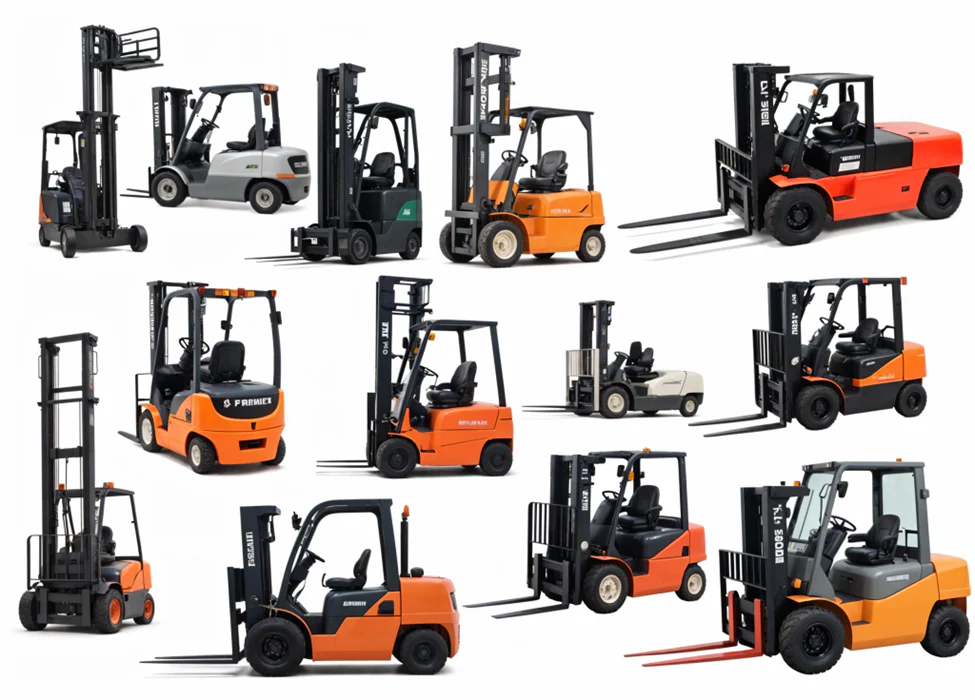
Here are the 7 most common types of forklifts, what each one was built to do, and how to figure out which is right for your operation.
Types Of Forklifts
| Type | Best For | Environment | Power Source |
| Counterbalance | General warehouse, loading docks | Indoor and outdoor | LP gas, diesel, electric |
| Electric Forklift | Indoor warehousing, cold storage | Indoor | Battery |
| Reach Truck | Narrow aisles, high-bay racking | Indoor | Electric |
| Order Picker | Fulfillment, item-level picking | Indoor | Electric |
| Electric Pallet Jack | Short-distance pallet movement | Indoor | Manual or electric |
| Rough Terrain Forklift | Construction sites, outdoor yards | Outdoor | Diesel |
| Telehandler | Construction, agriculture, roofing | Outdoor | Diesel |
1. Counterbalance Forklift
The counterbalance forklift is the most widely used piece of material handling equipment in the world, and for good reason. It is built around a straightforward principle: a heavy counterweight at the rear of the machine offsets the weight of whatever load is being carried at the front. No outriggers, no special rack systems, no complicated setup. Drive up to a pallet, slide the forks in, and lift.
These machines come in two primary tire configurations. Cushion-tire counterbalance forklifts ride on solid rubber tires and are designed for use on smooth indoor surfaces like concrete warehouse floors. Pneumatic-tire models use air-filled or solid foam-filled tires with more surface contact and are better suited for outdoor use, uneven pavement, or mixed-use environments where the machine might move between a warehouse and a loading yard.
Fuel options are just as flexible. Counterbalance forklifts can run on liquid propane gas, diesel, gasoline, or electricity depending on the application. LP gas models are particularly common in warehouses across DFW because they can be used indoors with proper ventilation and refueled quickly without long charging windows.
Lift capacity ranges widely, from 3,000 pounds in a standard warehouse model up to 15,000 pounds and beyond in heavy-duty industrial configurations.
Best for: loading docks, manufacturing floors, distribution warehouses, general pallet handling
Who needs one in DFW: almost any warehouse, distribution center, or manufacturing facility with regular pallet movement
Browse used counterbalance forklifts available in Dallas
2. Electric Forklift
Electric forklifts run on rechargeable batteries rather than combustion engines. No exhaust, no fuel storage requirements, and significantly quieter operation. Those three factors make electric models the preferred choice anywhere indoor air quality matters, including cold storage facilities, food-grade warehouses, pharmaceutical distribution, and retail environments.
The battery pack itself serves a dual purpose. In addition to powering the machine, it acts as part of the counterweight system, which is why most electric forklifts are compact and well-balanced despite having no rear engine block.
Running costs over time tend to be lower than IC forklifts. There is no fuel to purchase, the drivetrain has fewer moving parts, and maintenance intervals are generally less frequent. The tradeoff is the need for a dedicated charging infrastructure and some operational planning around charging windows. Businesses running two or three shifts often invest in spare battery packs to swap in rather than waiting for a recharge.
Lift capacities range from 3,000 to 40,000 pounds depending on the model. Three-wheel electric forklifts are a popular choice for tight indoor spaces because of their extremely short turning radius.
Best for: indoor warehousing, cold storage, food-grade facilities, retail distribution, any environment where emissions are a concern Who needs one in DFW: food and beverage distributors, pharmaceutical warehouses, grocery distribution, any facility where indoor air quality is regulated.
View electric forklifts for sale in Dallas
3. Reach Truck
A reach truck is purpose-built for high-density warehousing. Unlike a standard counterbalance forklift, a reach truck does not need to drive entirely into a racking aisle to deposit or retrieve a pallet. The forks extend outward on a telescoping mechanism, allowing the operator to place or pull a load from the rack without the machine itself entering the space. That mechanism is where the name comes from.
The result is a machine that can operate in aisles as narrow as 8 to 10 feet while still accessing rack heights of 30 feet or more. In a warehouse where floor space is expensive and vertical storage space is the primary asset, reach trucks are the equipment that makes high-density racking economically viable.
Reach trucks are electric-only machines, designed exclusively for smooth indoor surfaces. They are not suitable for outdoor use or loading dock work. Most operations that use reach trucks also have a counterbalance forklift or pallet jack on site to handle the loading dock and staging area work that a reach truck cannot do.
Best for: warehouses with narrow aisles and high-bay racking, 3PL providers, distribution centers with dense storage requirements Who needs one in DFW: third-party logistics providers, high-volume distributors, any warehouse investing in vertical storage density
Browse reach trucks in our Dallas inventory
4. Order Picker
Where a reach truck raises only the forks to retrieve a pallet, an order picker raises the entire operator platform along with the forks. The operator rides up to the pick level, selects individual items from storage racks, and places them on the platform. This design makes order pickers the go-to machine wherever businesses need to pick mixed or individual items from racking rather than moving full pallets.
Order pickers are standard equipment in e-commerce fulfillment centers, parts distribution operations, and any warehouse where orders are assembled from multiple SKUs stored at different heights. Common lift heights run from 20 to 35 feet.
Because the operator is elevated off the ground, OSHA requires that all order picker operators wear a full-body harness attached to the platform and that operators receive specific certification for this class of equipment. That is not unique to order pickers, but it is worth factoring in when planning a new fleet purchase.
Like reach trucks, order pickers are electric-only and are built for smooth indoor surfaces.
Best for: e-commerce warehouses, parts distribution, retail distribution centers, any operation picking individual units from height Who needs one in DFW: the DFW area’s growing base of e-commerce fulfillment operations and multi-SKU distributors
Ask about order picker availability in our Dallas inventory
5. Electric Pallet Jack
The electric pallet jack is the most accessible entry point into powered material handling. It does not stack, it does not rack, and it does not lift loads to height. What it does is move pallets quickly and efficiently across a flat surface, which covers a surprisingly large percentage of the material handling work that happens in smaller warehouses, retail stockrooms, and food-service environments.
Manual pallet jacks require the operator to pump the handle to raise the forks and pull or push the load by hand. Electric models add a powered drive system and powered forks, which dramatically reduces operator fatigue on high-volume shifts and opens the equipment up to a wider range of operators.
The typical lift height for a pallet jack is just a few inches off the ground. It is strictly a transport tool, not a stacking tool. In larger operations, pallet jacks are frequently paired with reach trucks or counterbalance forklifts. The pallet jack handles ground-level movement from the dock to the staging area, while the larger machines handle the racking work.
Best for: retail backrooms, grocery and food-service operations, unloading deliveries, short-distance pallet movement within a single floor level Who needs one in DFW: grocery distributors, restaurants, retailers, light manufacturing, any smaller operation that moves pallets without a full racking system
View electric pallet jacks for sale in Dallas, TX
6. Rough Terrain Forklift
Standard forklifts are built for flat, hard surfaces. A rough terrain forklift is built for everything else. Large pneumatic tires, high ground clearance, a powerful diesel engine, and a reinforced frame give rough terrain forklifts the ability to operate on mud, gravel, sand, uneven construction sites, and unpaved outdoor yards where a standard machine would get stuck or tip.
Capacities range from about 6,000 to 20,000 pounds. Lift heights are typically more modest than their indoor counterparts because the application is usually moving and staging materials at job sites rather than racking into height.
Construction is the most obvious use case. Rough terrain forklifts are the machines that unload lumber, steel, concrete block, roofing materials, and heavy equipment from flatbeds at active job sites across the DFW Metroplex. They are also common in nurseries, agricultural operations, pipe yards, and any outdoor materials business where the ground is not always smooth.
Best for: construction sites, lumber yards, steel yards, pipe and materials yards, nurseries, agricultural operations Who needs one in DFW: general contractors, homebuilders, outdoor materials suppliers, any operation working in unpaved or semi-improved environments
Browse rough terrain forklifts in our Dallas inventory
7. Telehandler (Telescopic Handler)
A telehandler combines the functionality of a forklift with the reach of a crane arm. The defining feature is the telescoping boom, which extends both upward and outward simultaneously. That means a telehandler can place a pallet not just at a height directly above it, but on a rooftop, over a wall, or onto a second-floor deck from a ground-level position.
Most telehandlers accept a range of attachments in addition to the standard fork carriage, including buckets, winches, work platforms, and augers. That versatility makes a single telehandler capable of covering work that would otherwise require two or three separate pieces of equipment on the same job site.
Typical lift capacities run from 5,000 to 12,000 pounds at ground level, with rated capacity dropping as the boom extends. Operators and project managers working with telehandlers need to be familiar with the load charts for their specific machine, since capacity changes significantly depending on how far the boom is extended.
Telehandlers are diesel-powered and built strictly for outdoor use. They are a staple on residential and commercial construction sites across DFW, particularly for roofing, framing, masonry, and any work that requires placing materials at elevation without a crane.
Best for: construction, roofing, masonry, agriculture, any application requiring material placement at height or distance Who needs one in DFW: general contractors, roofing contractors, masonry crews, agricultural operations
Browse telehandlers and heavy equipment for sale
How to Choose the Right Forklift Type
With seven types to choose from, the decision gets simpler when you run through four questions.
Where will it operate?
If the answer is indoors on smooth concrete, electric models and cushion-tire counterbalance forklifts are the right starting point. Outdoor or mixed environments point toward pneumatic tire counterbalance, rough terrain, or telehandler models depending on what the machine needs to do.
How high does it need to lift?
General pallet handling under 20 feet is well within counterbalance territory. Narrow aisle warehouses with racking above 20 feet need a reach truck. Item-level picking at height calls for an order picker. Placing materials on elevated structures at a distance is the telehandler’s job.
What is the rated load capacity?
Standard warehouse pallets in the 2,000 to 4,000-pound range are handled by most counterbalance and electric models. Heavier industrial loads, machinery, or bundled materials may require high-capacity counterbalance or rough terrain machines.
How many hours per day will it run?
Light or occasional use can be well served by a pallet jack or a single-battery electric model. Single-shift operations have a wide range of options across electric and IC. Multi-shift operations running the equipment nearly continuously often find that IC forklifts, or electric models with spare battery packs, make the most operational sense.
Buying vs. Renting in the Dallas Area
For most ongoing operations, buying makes more financial sense than renting once you know you will need the equipment regularly. A well-maintained used forklift at a fraction of the new price can deliver years of reliable service, which is why the used market is particularly strong across DFW’s warehouse and construction sectors.
Short-term projects, seasonal volume spikes, or situations where you want to trial a specific type before committing to a purchase are all strong cases for renting. Local Forklifts carries rental inventory across multiple equipment types and can help match the right machine to your project timeline and budget.
If you have equipment sitting idle, there is also the option to sell. Local Forklifts purchases used forklifts and equipment directly, and the process is straightforward.
Ready to find the right forklift for your operation? Local Forklifts serves the Dallas-Fort Worth area with a wide inventory of used forklifts, rental equipment, and expert guidance across all seven types covered above. Browse the inventory online or give the team a call for a no-pressure recommendation.