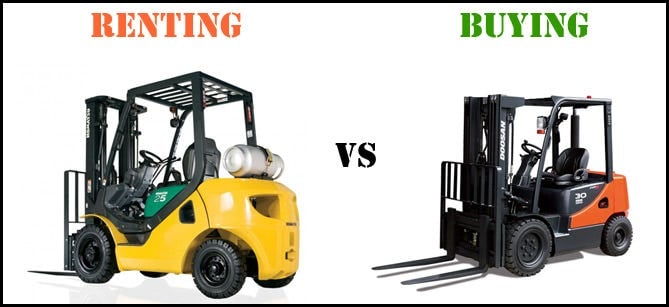
It is one of the bigger equipment decisions a growing business makes. You need a forklift. What you have not settled is whether to rent one or buy one outright. Rent and you keep your cash free but pay more over time. Buy and you own an asset but tie up capital and take on maintenance.
The good news is that this decision is more math than guesswork. There is a clear way to figure out which option costs you less based on how much you will actually use the machine. This guide walks through that calculation, lays out when each option genuinely makes sense, and covers the used equipment angle that often turns out to be the smartest play of all.
[Internal link: If you are leaning toward renting, our forklift rental cost guide breaks down current Dallas-area pricing by machine type and term.]
The Short Answer: It Comes Down to Utilization
Before getting into the details, here is the single most useful concept for this decision: utilization. It is simply how many hours the machine will actually be working.
The industry rule of thumb is that 100% utilization equals roughly 176 hours per month, or about 22 working days of single-shift operation. The practical threshold most dealers use is around 60% utilization, which works out to roughly 24 hours of a standard 40-hour week.
The logic is the same one you would apply to hiring. You would not pay someone a full-time salary to work 24 hours a week and stand idle the rest of the time. A forklift is the same. If the machine will run most of the time, owning it is usually cheaper per hour. If it will sit idle for long stretches, renting only when you need it almost always wins.
As a quick gut check:
- The machine will run daily, most of the day, for the foreseeable future → lean toward buying
- The machine will run intermittently, seasonally, or for a defined project → lean toward renting
Everything below builds on that foundation.
How to Run the Break-Even Math
The actual calculation is straightforward. You are comparing what you would spend renting over a given period against what you would spend owning over that same period.
Step 1: Estimate how long you need the machine
Be honest about this. A three-month project is a rental. An ongoing operational need with no end date is a different conversation.
Step 2: Calculate the rental cost over that period
Using current Dallas-area rates, a standard 5,000-pound forklift runs roughly $1,300 to $1,850 per month. Over six months, that is somewhere between $7,800 and $11,100.
Step 3: Compare against ownership cost over the same period
A quality used 5,000-pound forklift might cost $12,000 to $20,000 to purchase outright. A new one runs $20,000 to $40,000 or more depending on fuel type and specs.
Step 4: Find your break-even point
At some point, the cumulative rental cost crosses over and exceeds what it would have cost to own. For most standard machines under regular use, that crossover tends to land somewhere between 12 and 18 months of continuous rental.
If you will need the machine well past that break-even point, buying is the better financial decision. If your need ends before it, renting is cheaper and keeps your capital free for other uses.
When Renting Makes Sense
Renting is the right call more often than people expect, particularly for businesses that value flexibility and predictable costs over ownership.
Short-term projects
If you need a forklift for a specific job with a defined end date, renting is almost always the answer. There is no reason to own a machine you will not need in three months.
Seasonal demand.
Many DFW businesses see volume spikes at predictable times of year, whether that is a holiday retail rush, a harvest period, or a construction busy season. Renting lets you scale up exactly when you need to and scale back down without owning equipment that sits idle for half the year.
Intermittent or variable use.
If your forklift needs come and go, paying only for the time you use the machine is more efficient than carrying the full cost of ownership year-round.
Preserving capital.
Renting requires no large upfront outlay. Instead of putting $15,000 or $30,000 into a machine, you make manageable periodic payments and keep that capital available for inventory, payroll, or other investments.
No maintenance burden.
Routine maintenance and most repairs are handled by the rental company. You do not deal with scheduling service, managing breakdowns, or budgeting for upkeep. With Local Forklifts, insurance is also included, removing another cost and administrative step.
Trying before buying
If you are not sure which machine type or capacity is right for your operation, renting one for a few weeks is a low-risk way to find out before committing to a purchase.
Tax treatment
Rental payments can often be deducted as a business expense in the year they are made. This is worth a conversation with your accountant, since the right treatment depends on your specific situation.
When Buying Makes Sense
Ownership is the better path when the machine is a core, everyday part of how your business runs.
Daily, high-hour use: If a forklift is running most hours of most days, the per-hour cost of owning it drops well below the cost of renting. At high utilization, ownership simply wins on the numbers.
Long-term need: If you expect to use the machine for more than five years, buying almost always comes out ahead. You spread the purchase cost across years of service, and the average cost per hour keeps dropping the longer you own it.
You want an asset: A forklift you own is an asset on your books. When it comes time to upgrade, a well-maintained machine carries resale or trade-in value that offsets the cost of its replacement. A rental returns to the dealer the moment you stop paying, with nothing to show for it.
Full control: Ownership means the machine is always available, configured how you want it, maintained on your schedule, with no usage caps or overtime charges for running it hard.
Tax depreciation: Owned equipment can typically be depreciated over its useful life, which may offer tax advantages. As with rental deductions, this is a question for your accountant based on your circumstances.
The Option Most People Overlook: Buying Used
A new 5,000-pound forklift might run $30,000 or more. A well-maintained used equivalent with plenty of service life left can come in at half that. For a business that has crossed the utilization threshold where ownership makes sense but does not want to commit new-equipment money, used is frequently the smartest financial move available.
There is a third path that often delivers the best of both worlds, and it is the one many businesses do not fully consider. Buying a quality used forklift can cut the purchase price by up to 50% compared to new while still giving you all the advantages of ownership.
The key is buying from a source that stands behind the machine. The things that matter most when evaluating a used forklift are the total hours, the maintenance history, and, for electric machines, the condition and age of the battery. A reputable dealer will be transparent about all three.
This is squarely where Local Forklifts operates. Because we handle both rentals and used sales, we are not pushing you toward one option to move a particular piece of inventory. If renting genuinely makes more sense for your situation, we will tell you. If a used purchase is the better long-term play, we can show you machines that fit. The goal is matching you to the right decision, not the most expensive one.
[Internal link: Browse used forklifts for sale in Dallas]
A Quick Decision Checklist
Run through these and the answer usually becomes clear:
- Will the machine run daily for most of the working day? If yes, lean buy. If no, lean rent.
- Is this for a defined project with an end date? If yes, rent.
- Do you expect to need it longer than 12 to 18 months? If yes, buying likely wins on cost.
- Is your demand seasonal or unpredictable? If yes, rent.
- Do you want to preserve capital this year? If yes, rent, or consider a used purchase to lower the outlay.
- Do you want an asset with resale value? If yes, buy.
- Are you unsure which machine is even right? Rent one first and find out.
The Bottom Line
The rent versus buy decision comes down to how much you will actually use the machine and how long you will need it. Low or seasonal use favors renting. Daily, long-term use favors owning, and for most businesses that cross that line, a quality used machine delivers the best value of all.
If you are still weighing it, the Local Forklifts team works through this exact decision with DFW businesses every week. We rent, we sell new, and we sell used, so the recommendation you get is based on what actually fits your operation and budget rather than what we happen to have on the lot. Tell us how you plan to use the machine and we will help you land on the right call.